Why you can’t make good decisions when you’re stressed
You’re pacing the living room at midnight, job offer open on your laptop along with the notes for your big meeting tomorrow. You’ve been working and trying to figure this out for hours, but you’re even more confused now than when you started and are starting to question why anyone would hire you for anything, as well as why you’re doing any of this to begin with. Your thoughts are racing right along with your heart as nervous energy practically radiates from you.
Is this a common scenario? Yes. But is it just pre-decision jitters? No, it’s a dysregulated nervous system that’s actually, physically, harming your ability to think clearly. You won’t be able to make a good decision until you convince your body that you’re not under fire.
Why thinking harder doesn’t help, and what does
As a former super-thinker and (still) lover of data points myself, I fully understand the impulse to try to think your way to the right choice. Whether you’re deciding on a job offer like our stressed out friend from earlier, or where to send your kids, or how to approach a big meeting or a problem at work, we typically think that we are just one key fact away from seeing the light.
This is rarely true.
Unfortunately, when we are under a lot of stress, our prefrontal cortex (the reasoning center of the brain that you need in this precise situation) actually shuts down. That’s why as you spin yourself up over a decision you likely find yourself feeling less certain about it over time. Not ideal.
You may experience this even if you aren’t staring down a big decision or situation. If you’ve had a series of stressful events / days / years, the body can get “stuck” in this high stress state and struggle to return quickly or at all to a relaxed, calm state. This is why, at peak stress, you may go on vacation or on a spa day and feel like you can’t relax or come home feeling no better after a week of down time.

How to regulate your nervous system
You don’t need more pro/con lists or massages, you need regulation. What is regulation, you ask? It is basically teaching the body to better regulate its nervous system and handle stressful events by physically calming down the body. Specifically, the idea is to down-regulate the vagus nerve, and manually demonstrate that we are safe. When we do this repeatedly and across different modalities, our body learns to regulate in the moment where we previously would have become stuck in a stress response. When we do this, our prefrontal cortex comes back online, we can think clearly again, and while the actual circumstances may be the same, they will feel very different.
Tools to regulate your nervous system
There are many things that help regulate your nervous system, and some will work better than others for each person. Here are a few that you can test out:
- Breathwork: This has become popular lately, and for good reason – our breath is incredibly powerful and it signals to our body what is going on and how to respond. By consciously breathing slowly, deeply, and using a pattern, you are physically telling your body that it is safe. Try one of the following to start:
- Box breath: Breathe in for 3, hold for 3, out for 3, hold for 3. There are four sides of a box, and four elements of each round of this breath. This slow, steady breathing signals that you are sitting safely somewhere and not being chased by a bear. You can adjust the counts (use 4, or 5, whatever feels comfortable).
- Coherent breath: This is simply slowing down and breathing deeply and regularly. You can count this yourself – in for 5, out for 5, or choose the number you like. Alternatively, there are a number of videos and tracks that you can follow along. My personal favorite is called 2 Bells, it’s very simply…you guessed it…two alternating bells where you breathe in for one and out for the other. Incredibly calming.
- Bonus: Heartmath: For all you data nerds out there like me, Heartmath is a device that allows you to see your real time heart rate variability (HRV) and how it changes as you use these breathing techniques, or meditation, or visualization. Once I saw with my own eyes how impactful breath and focus techniques are in the moment it made it a lot easier to stick with them.
- Contrast therapy: sauna / cold plunge: Another one that has become all the rage lately – love when healthy things get popular. You can think of this one as interval training for your nervous system – the cold plunge acts as a stimulus, which actually upregulates the nervous system, and then the sauna reverses it, quickly bringing the body down into a more relaxed state. By going between them, you train your nervous system how to both manage and feel safe in a stressful environment (cold) and that it can and should quickly downregulate when placed in the relaxing environment (hot). As a bonus, one of the upregulating hormones released in the cold is dopamine, so this practice also feels awesome and becomes a big addicting after you’ve done it a few times.

- Compression / pressure: Stay with me here – this may not seem obvious at first. But consider that we are hardwired from birth to understand that swaddling and hugs are positive things, and they trigger safety to the nervous system. There are a number of different ways that we can get at this, and it’s ok / encouraged to use multiple of these.
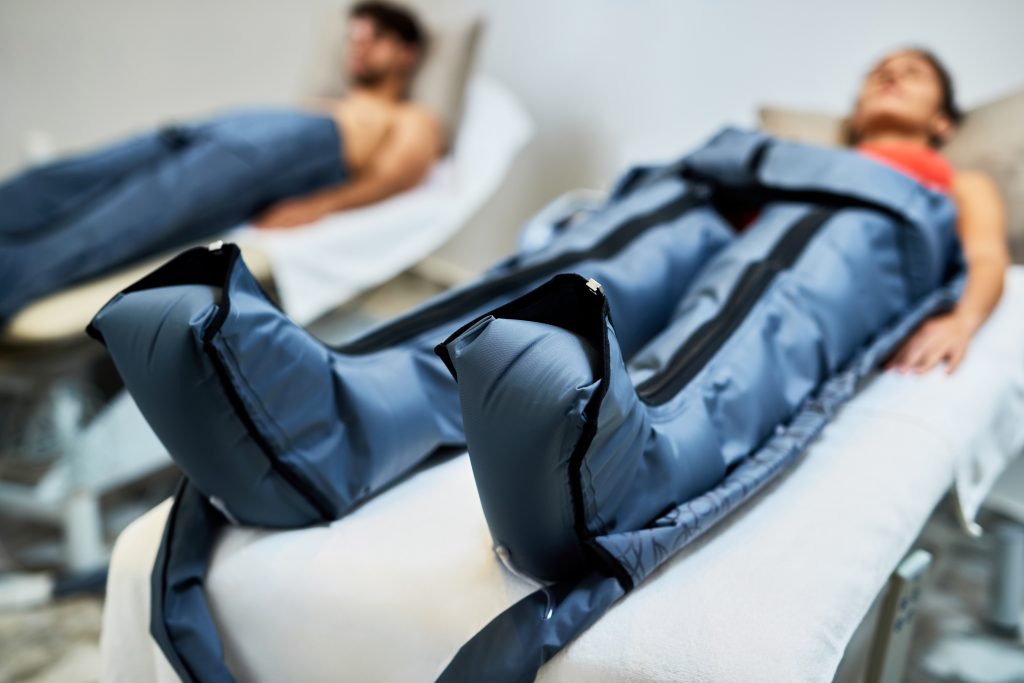
- Compression boots / hips / arms: Made famous by Normatec (now Hyperice) but lots of companies make them now. A session in these with the rhythmic squeezing is both regulating and good for sore muscles.
- Weighted blanket: People find this comforting for good reason. It’s one of the only things that helps calm my pup during a thunderstorm, in fact.
- Legs up the wall: This is self-created compression. Basically your legs being up compresses everything back down and tells your body that it’s safe, pressure is off the legs and there is plenty of blood in the torso. It’s exactly how it sounds – scoot up to a wall on your back, get your butt as close to the wall as you can with your legs over to the side, then swing them up. You may want a pillow or blanket under your head and / or hips for comfort. 5-15 minutes is a good amount of time per session, and it can be especially nice before bed to help relax the body for sleep.
- Hugs: Yes. The original compression. And it absolutely counts. Humans, dogs, kids, whatever works for you. Go for at least 20 seconds and (I hope this goes without saying) mutual contact. I understand that a dog can’t hug, but you can generally get a lean or a tail wag versus clawing for escape. You get it.
How long does it take to feel results?
These tools, like many healthy things, work with regular practice. You might actually feel more of a noticeable shift right at first since it’s new, or you may find it builds up for you over time. Either way, you’re likely to find yourself with a clearer mind, less reactionary, and more prepared to take on whatever decision or task you have next. Personally, I find that if I’m muddled up over something, a solo sauna / cold plunge session where I focus on enjoying the experience can result in a totally different perspective on the situation.
What’s next
Critically, if you are at a decision point, these practices will prepare you for the next step, which is to begin to learn to listen to yourself again.
Sound crazy? Just think of all of the times you’ve ignored or pushed down your thoughts, needs, etc for the job or commitment that you have. Had a terrible day at home but plastered on a huge smile for the board meeting? Or maybe you disagreed in your very soul with the company’s decision, but it was your job to execute it. In no way am I saying you shouldn’t have done those things – I’d be the biggest hypocrite in the world. But what isn’t often acknowledged is the tradeoff. When we do that, we tell our mind and body that it isn’t important, that it isn’t right or the priority. And slowly over time, it gets quieter and harder to hear, drowned out by the megaphones of work demands, family needs, the “shoulds” and the “what other people think.” All is not lost, we can always get it back, but it is like a muscle that takes time, practice and reps to rebuild. And it’s very hard to do with the additional static noise of an unregulated nervous system, so if you’ve followed this article you’re already partway there.