Wellness retreats are having a MOMENT right now. It makes a lot of sense…health and wellness is a focus right now, travel is growing, burnout from work and life and everything is at an all-time high. Put all of that together and you have the perfect storm of reasons to try a wellness retreat for your next trip. There’s nothing quite like coming back from vacation actually relaxed instead of ready for a vacation from your vacation.
Keep reading to learn more about the benefits of wellness retreats, the types, examples of each, and how to choose the right one for you.
This post may contain affiliate links. If you purchase through these links, I may earn a small commission at no additional cost to you. I only recommend products and services I genuinely use or believe in.
What is a wellness retreat?
So what is this wellness retreat I speak of, exactly? Well, it could be a lot of things.
You could create a DIY wellness retreat by visiting a gorgeous hotel in an environment that you love and scheduling daily spa treatments and workouts and tracking down healthy restaurants in the area. At the other extreme, you could visit a wellness retreat planned for certain dates at a certain time with a smallish group, which would include some type of movement, some particular eating approach, some amount of relaxation. Or, you might visit a resort dedicated entirely to wellness where everyone is on their own retreat of their own making as they select activities (or not) each day.
Different retreats will have different focuses and approaches and vibes. At the end of the day, it’s any trip, planned by you or someone else, with the purpose of getting away to focus on whatever wellness means for YOU.
Keep reading – or jumping around in the table of contents – to learn more about the different kinds of retreats, how to choose the best one for you, and how to get the most out of it.
The history of wellness retreats
Wellness retreats have been around a LONG time. Ancient Greece had healing sanctuaries called Asclepions that offered everything from dream interpretation to exercise to hydrotherapy. Ancient Rome had public bathhouses, called thermae, that served both socializing and relaxation purposes. Ancient India had and still has Ayurvedic practices, which focuses on both physical and mental health.
In the 19th century, sanatoriums (promise it’s a good thing, though the name doesn’t sound great) became popular. These were mostly in Europe and offered hydrotherapy, fresh air and exercise, and could vary from the very cheap to the very luxury.
In the last few decades the focus on wellness has returned – exercise, spa treatments, yoga, and more recently sauna and other recovery treatments. You can find a retreat for almost anything wellness-related that you’re into.
Benefits of wellness retreats
This isn’t rocket science. Yes, getting away and doing things that feel good and are relaxing will be a positive experience. But let’s talk a little about the whys and the whats of the benefits.
Mental benefits
The brain changes physically when you put it in a new environment. It has to figure out new surroundings and process information that was previously on autopilot. It changes neural pathways, adding and taking away. It helps with creativity and problem solving. Why does this matter? Because you probably wanted a wellness retreat for a reason – you needed a break, a fresh start, a new idea, whatever it is. The new environment alone, before any retreat-related activities even come into play, is impactful.
Stress and nervous system recovery
Going somewhere where you focus your time on exercising (even if it’s just walking), relaxing, doing positive things for your body, and slowing down will reduce your stress and help your nervous system unwind. Depending on what specific activities you choose, you can get additional benefit here – such as sauna, PEMF, breathwork, and others.
Visiting a new place, any new place, gives your brain new things to focus on, supports problem solving and creativity, and therefore takes it away from ruminating about whatever your typical talk track is. You’re also physically taking yourself out of any environments at home that might cause you stress, like work, family dynamics, etc. Exercise reduces stress, as of course do spa treatments. Nature naturally reduces stress, and even just looking at wide horizons and far out into the distance (which you may not do often at home) calms the brain. The list of ways a retreat can reduce stress is almost endless.
Physical benefits
Wellness retreats often have healthy nutrition, exercise, and relaxation or even spa time. All of these things help your body in a myriad of ways. These include:
- Alternative nutrition: You’ll likely eat differently at a retreat than at home, and theoretically, it will be better. There is typically some type of nutrition approach, whether it’s vegan / vegetarian, anti-inflammatory, etc. What it almost certainly won’t be is processed junk, and often you can’t even get that if you wanted to at these places. Your body will appreciate that.
- Increased movement: Whether you’re hiking, doing yoga, swimming, or just walking around more, you’re likely moving more than you would be at home, and you’re likely doing more of it outside. Specific physical limitations aside, more movement is almost always better for the body.
Types of wellness retreats
There are endless types of retreats. I’ll lay out a few of the most common here so you have an idea of the landscape.
Luxury wellness retreats
A retreat set at a very high end resort or hotel and typically with all inclusive food, activities, etc. You just show up to the property, select your activities, and don’t worry about anything. Activities include wide varieties of spa treatments, exercise, hydrotherapy, mindset work, meditation, breathwork, and many other more unique wellness treatments. Some include medical offerings as well. You can typically visit whenever you like rather than having to identify certain retreat dates and groups to join. This includes properties like Canyon Ranch, Golden Door and Amangiri in the US, and Six Senses all over the world.
Yoga + meditation retreats
This is perhaps the most common type of retreat and what people most often think of when you talk about a wellness retreat. There is yoga of various types, food, sometimes other activities related to exploring the location, getting to know the other yogis, etc. These are often put on at a retreat center or hotel over a discrete time, versus others where you can visit anytime. There are an endless amount. Yoga For Bad People (I love their name) puts on their own retreats throughout the world, Kripalu is in the US, Blue Osa in Costa Rica, Blooming Lotus in Bali, Costa Dulce in Nicaragua, and a truly endless number in India. Additionally, yoga studios often create their own retreats, which are typically at a resort or retreat center and for a set date and duration.
Adventure + nature retreats
These retreats are often set in an amazing natural environment where you stumble out the front door and find yourself in paradise. They may have a focus, like biking, hiking, or surf, or they may have a variety of nature activities as options that you choose from. Trek Travel and Duvine offer road bike trips, Sacred Rides offers mountain biking, Body Holiday in St Lucia has a wide range, Mountain Trek in Canada offers hiking (as you might guess) plus a variety of other fitness and nature experiences, and many more.
Medical / functional medicine retreats
Some retreats are truly medical in nature. They take the opportunity to do tests and spend lots of time understanding the patient to get to the root of whatever he or she is trying to change. Programs typically include things like Longevity, Detox and / or Weight Loss, Executive / Leadership Performance, and many more. Admittedly, this category has some overlap with the luxury one because many of those have a medical option – but participants can ignore it completely and have an amazing time. Palazzo Fuiggi and Lanserhof are in Europe, SHA has Spain and Mexico, Pritikin Longevity Center is in Florida.
Burnout / nervous system recovery retreats
A newer type of retreat is focused on helping the nervous system downregulate. This might include similar things to some of the other retreats, but the focus here is understanding the nervous system and how rest alone isn’t enough to come back from years of fight-or-flight. Re Precision Health offers this in both Mexico and Portugal.
Specialty retreats
There are some truly unique retreats out there. There are darkness retreats where you stay in the dark for days at a time, such as Sky Cave Dark Retreats – I hear things can get weird. There are silent retreats, often through Vipassana centers, but other places too. Aerial arts retreats exist where you go flip around on silks and lyra and such, or crossfit retreats for the intensity lovers. Digital detox retreats are rising in popularity as well, such as Eremito in Italy, where you are left device and connection-free. No matter which approach you take, you’re certain to learn something about yourself and come back changed.
Cost of wellness retreats
Just like anything else, you can spend a little or you can spend a lot. What you’ll get will vary widely.
Budget (>$1500)
Yes, these do exist! You can still expect transformation, but don’t expect luxury. To get a retreat in this price range, you’re typically looking at one of the following:
- A retreat in a lower cost of living location that will be more expensive / time-consuming to get to, such as Serenity Eco Guesthouse and Yoga in Bali, where you can do a 7-day all-inclusive yoga retreat for under $500. Essence Arenal in Costa Rica offers 7-day all-inclusive retreats for around $1200, depending on which package you choose.
- Visit a retreat with options for very basic accommodations, such as The Art of Living in North Carolina or Kripalu in Massachussetts. You can choose to share a room or get your own, but ideally you’ll be out enjoying the property so the room isn’t that critical.
- DIY a retreat for yourself. Select an environment that you enjoy (e.g., beach, mountains, etc), find an affordable hotel, and identify places to do the activities that you’re interested in such as fitness or yoga studios, spas, hiking trails, art classes, etc. Find healthy restaurants or get a place with a kitchen so you can make your own healthy food. More legwork, but it’s possible.
Mid-range ($1500-5,000)
The offerings in this range can vary widely. You’ll likely get nicer accommodations, assuming you’re not an an eco-retreat place where part of the experience is the rustic space. A week at Costa Dulce in Nicaragua, including daily spa treatments, surfing and / or yoga and meals us under $5K for two people. Re Precision Health in Mexico offers a 5 day nervous system reset retreat for $3-5K for two, depending on the room you choose. Blue Osa in Costa Rica offers a “create your own” retreat including adventure activities, yoga and spa for $3-5K for two for 7 nights.
Luxury ($5K+)
The sky is really the limit here. Canyon Ranch, available in the Berkshires, AZ and CA, typically starts around $1200 per night for their inclusive offering. A 7-night Stress Resilience Program at Lanserhof in Germany starts around $9K per person. Six Senses Crans-Montana, which is perched in the Swiss Alps, offers a wellness package for about $1400 per night for two people.
How to choose the right wellness retreat for YOU
Now that I’ve properly overwhelmed you with information, let’s get into how to make this choice for yourself. There are a ton of retreats and choices you can optimize for, so I’ll break down how to approach it in a way that doesn’t make you need the retreat even more.
First question: what constraints do you have? Below is a list of factors that you will want to consider in your decision process. Which of those are absolute non-negotiables for you? That will help you zero in on the right choice.
- Region of the world: Are you open to a 20+ hour flight to Bali, or do you want to stay in your home country, or even within driving distance? Do you also want to use this as an opportunity to explore a new country or city, or will you be staying in the resort so it doesn’t really matter what’s out there?
- Travel required: Some retreats take a little effort to get to – but they’re worth it for the natural beauty! Blue Oso in Costa Rica is a hopper flight from their main city, so that flight is included in their rates. Costa Dulce in Nicaragua is a very bumpy ride in from wherever you fly into, and if you fly into Costa Rica, you have a land border crossing to do. They’ll help you with all of it, but it takes some time and willingness. If you want a quick and easy travel experience or you only have a short time, make sure you check for that.
- Cost: What is your budget? As we just discussed, costs can vary WIDELY and you can have a great experience across the whole range as long as you know what you’re signing up for.
- Dates & duration: Do you have a set amount of time off from work, or want to go at a certain time? If so, you might have trouble matching up with one of the retreats with set dates. Are you flexible within a few months? You might be able to do a set retreat, or find deals within that time frame.
- Structure / format: Do you want to completely DIY your own retreat, do you want a wellness resort where you choose your activities and schedule but it’s all there for you, or do you want a structured program where you’re handed an itinerary when you arrive? Do you want to be a part of a group and get to know people, or do you want to be solo and doing your own thing?
- Activities / offerings: What do you want to do? Yoga, any specific type of fitness, breathwork, meditation, aerial silks (yes these retreats exist), surfing? Are you looking for any medical offerings? Spa, hydrotherapy? Do you want wellness things you haven’t even heard of before to open your mind? Adventure stuff like zip lining or rafting or biking?
- Food: Retreats often have some kind of stance on food, whether it’s locally grown, or vegetarian / vegan, or anti-inflammatory (I love this one), or organic, or something else. If you have food restrictions or strong preferences, make sure you know what you’ll be eating for the week! At smaller places, there is sometimes only one family-style meal made, be aware of that.
- Accommodations: Theoretically, you’ll spend much of your time out enjoying the retreat, but sleep is an important part of wellness, so being in a place where you feel comfortable and enjoy the space is relevant, too. Many of the more luxury retreats offer a luxury hotel room, similar to what you might experience at a Ritz or Four Seasons. On the other end of the spectrum, at Kripalu (an economy choice) there are shared room options with bunk beds. Costa Dulce has the most amazing little jungle huts with screens, not windows, no air conditioning, where you can hear the waves crashing on the beach down below 24 hours a day. This was a dream for me, but if you’re expecting the Ritz, it’s going to be tough.
- Goal: Do you just want to get away and focus on yourself, or is there a specific area that you want to address, such as weight loss, nervous system reset, or a certain type of fitness or activity? There are all kinds and flavors of retreats out there that might meet your particular need and interest.
Based on all of that, you probably have a good idea of what matters to you and what doesn’t. Now, you can start looking based on your constraints. Bookretreats.com can have a lot of good options for set duration retreats, or if you’re looking for a retreat property, searching for lists of top retreats within the area or type of activity or whatever constraint you have typically is a good place to start. From there, reviews are critical, including reading the text. If someone reviewed a property well or poorly but was looking for a totally different thing from you, you’ll want to know that. Checking flight options before you book is a smart idea, too, because if you find an affordable retreat that’ll cost you thousands to get to, you’ve defeated the purpose.
How to do a DIY wellness retreat
Don’t have the time or money to do a planned retreat, or do you just have your own preferences that you want to meet? A DIY retreat might work for you! Here’s how to do it:
- Decide on a location: In your home, close to home, or elsewhere?
- Home: A retreat in your home is certainly possible, especially if you’re able to be there alone or just with your partner, if you want to do the retreat together.
- Airbnb or hotel in your city: The most ideal situation is to go elsewhere so that your brain has a chance to experience a new place. This literally rewires it as it has to take in new things from all senses, and helps to increase creativity and problem solving – two things that are often lacking in a burned-out brain. An Airbnb or hotel in your same city that you’ve never visited before does the job!
- Airbnb or hotel in another city or country: Is there a place you’ve wanted to visit, or a type of scenery that always calms your mind? Go towards that! Or, is there a certain type of activity or workout that you want to incorporate? Find a city with that.
- Find and book activities: Find a fitness or yoga studio, hiking trails, whatever you’re into, nearby your location and book as needed. Same for spa services, healthy restaurants, maybe even a creative class that you’ve wanted to try – candle-making, painting, clay pottery? Many studios exist where you can drop in for sauna / cold plunge, PEMF, red light, wellness infusions, and more. You can also bring some of your own activities such as in-room spa experiences, guided journals, that craft you’ve tried to get to for years…this is completely your time and the world is your oyster. Are you a bookworm and you want to spend hours a day reading? Amazing! Find a place with lovely little reading nooks and spend lots of time there.
- Notify your people and truly disconnect: A key element of a wellness retreat is being able to actually shut off from the work and typical responsibilities that tug at you. Make sure that your people are aware that you are doing this trip for yourself and that you will not be reachable except for emergencies. You can even give yourself a bit of a digital detox by leaving your phone behind during the day, turning it off except during set times, etc.
Watch outs for wellness retreats
In no way am I here to put a damper on things, but just a few quick ones to think about as you search for your retreat:
- Read reviews: Make sure you ONLY book a place with good reviews, and READ the reviews. Make sure you know what you’re getting into. I was once at an eco-lodge type of retreat that I absolutely ADORED, and a couple arrived for their honeymoon. Apparently they had seen the nearly-5 star rating and pressed book without realizing that this is an absolutely amazing but not at all luxurious property. Sometimes key info is only found in the reviews.
- Check the weather: …specifically for the time you’re going. Make sure you know if you’re signing up for blistering heat or the cold season. Some retreats run year round and assume you’ll realize what you’re getting.
- Plan every travel step: In some countries it won’t be easy to “figure it out” once you get there, or the retreat might be far from the airport. Also, make sure that the times that your flights arrive and leave work for the retreat and don’t leave you sitting at the airport for hours or having to spend an extra night somewhere.
- Check the cancelation policy: Some retreats have a no cancelation policy; they have limited space, they’re paying up front, whatever it is. Either way, make sure you are very clear on what you’re signing up for before you book and pay, and consider trip insurance if you can’t cancel and think there is a chance that you might need to.
- Be aware of ALL of the costs: Make sure you calculate and compare total costs. Different retreats and resorts will have different policy – things like transportation to and from the airport, any kind of resort or spa fee, taxes, tips, and more could be on top of the total that you see when you check dates. This may be fine, just don’t let it surprise you later.
- Travel / medical insurance: Depending where you are and what you’re doing, your travel and / or medical insurance may not apply, or it may be hard to access. For example, if you’re hiking somewhere remote in another country and need medical attention, is medical evacuation covered? Are any specific activities included? Worth a check.
- Contraindications or accommodations: Make sure that everything involved in the retreat works for you and any medications or conditions you might have. If you need to do a quick check with your doctor for anything, it’ll be a lot easier when you’re at home! Similarly, if you have a dietary requirement or mobility / ADA need, everything will go much more smoothly if you verify that it can be accommodated in advance and give the retreat a chance to prepare.
- Do what’s right for you: Just because a retreat is offering something it doesn’t mean it’s right for YOU. If something sounds funny to you, ask about it. If you think “I might die if I have to drink juice for 7 days but I guess they know what they’re doing…” don’t assume that! You’re spending your time and money to be somewhere, make sure it’s something that truly works for and feels safe and enjoyable for YOU. As I say in my sauna / cold plunge classes, everything here is offered as optional – you can do some, all or none and no one will think twice about it.
Solo travel to a wellness retreat
Considering doing a solo wellness retreat? First of all, I completely recommend it – I’ve done it and loved it. It’s nice to be able to completely do what you want to do and experience it through your own eyes only. Going with a friend or a partner is a great experience as well, just a different one. Here are a few things to consider if you’re going solo.
- Look at reviews from solo travelers specifically: Often, if a place has a lot of reviews, people will specify that they traveled there solo and share their experience. You can search for words in reviews on Google, Trip Advisor, and others. This can be very helpful for servicing potential issues or positive elements that you might not otherwise even think to ask.
- You’ll fit right in!: It’s SO very normal to travel solo, especially to a wellness retreat. When I went solo to the Re Precision Health retreat, there were multiple other solos there and I never felt left out or alone. Everyone chatted and hung out with everyone, people there with a partner or friend also went off and did their own thing sometimes – it’s completely normal.
- Check the details to make sure you feel comfortable: Make sure you fully understand the sleeping arrangement, both in your room and in your building, and that you feel good about it (same gender vs mixed, etc). Check that staff is onsite overnight. Anything that you are wondering about that’s making you nervous, just ask! If they don’t get back to you or are cagey about it, that might be an answer in itself.
How to prepare for your wellness retreat
You’ve booked, you’re excited, you’ve taken time off. Let’s get ready to go.
Packing
First and foremost, this trip is about you being well, feeling well. With that in mind…
- Clothes: Bring clothes that will make you comfortable and will work well for whatever you’re doing. Yoga / fitness clothes, casual clothes. Even when you’re relaxing, it can be nice to put on something a little nicer for dinner if that makes you feel good, or if you want to go all casual all the time, that’s typically fine. See if your chosen location has any guidelines here.
- Bug spray / sunscreen: If you’re going somewhere tropical, you’ll almost certainly want both of these things.
- Journal: One of the main things you’ll be doing here is listening to yourself, and slowing down enough to actually make that happen. A journal can be a good way to work through whatever is on your mind. You might even consider trying out Morning Pages, which is a concept from Julia Cameron’s fantastic book The Artist’s Way. Ideally you’ll have a paper journal and pen, but if you’re a die hard ipad / apple pencil or straight up computer journaler, you do you.
- Bathing suit: It’s incredibly likely that there will be something bathing-suit worthy. Pool, hydrotherapy, spa, sauna, something.
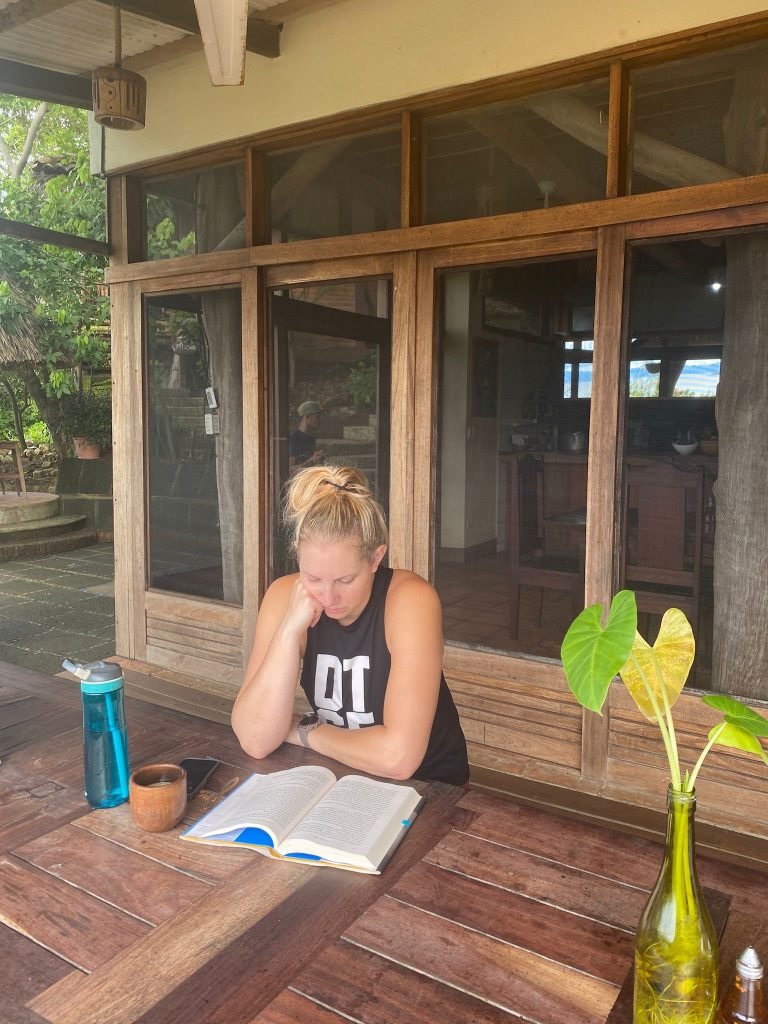
- Books: By no means is reading required on a wellness retreat. But you may find that, once you have a little breathing room, reading sounds good. Go for whatever sounds most interesting to you. Thriller, romance, fantasy, sci-fi, non-fiction, whatever. I really enjoy finding used books and leaving them there after I finish (often there is a take a book / leave a book type of situation at these places), or maybe you’re a Kindle person (I also do this).
- Comfort items for the room: This is particularly for those that are a little more eco-lodge or shared, basic accommodations. Take a close look at the photos of where you’ll be and ask questions if you’re not sure. You may greatly appreciate a little bedside fan, noise machine, eye mask, ear plugs, anything you find important that you don’t see there or could imagine needing in that scenario.
- Reusable water bottle: You’ll almost certainly want this, as most retreats will have water available. If you’re going to a hot place or even if you’re not, electrolyte powder is smart too.
- A small first aid kit, medications, and copies of Rx: It’s so nice to have a quick band-aid or advil or whatever it is if you need it. Of course you’ll want medications, and it’s smart to have prescriptions with you just in case something unexpected happens and you need to replace them locally.
- Snacks: If you’re particular about food, like to eat many times a day, or just have particular snacks that you like, consider bringing some of your own. Hunger is not a fun thing when you’re trying to relax.
- Adaptors / power banks: If you’re going to somewhere remote and / or eco-lodge, you’ll want power banks. Electricity can be spotty sometimes, so it’s good to have a backup. Of course, check the plugs in the country you’re visiting and bring adaptors if different from your home country.
Tech preparation
- Be truly OOO: Set up an auto-reply on your email so you don’t worry about it. Be honest – if you’re not going to check and someone should text / call if they truly need you, tell them that.
- Limit screen time: Identify “tech windows” when you’ll use your phone / computer / tablet, and stick to them. If you let yourself, it’s easy to look at your phone many micro-times per day. Leave it in your room if you can.
- Social media: Consider instituting a no doom scrolling policy during the trip. You are in a beautiful place, with amazing activities, you have books and journals and other people and nature…IG and Tik Tok can wait. It’ll all still be there when you get back, and you’ll return with a much clearer mind.
- Download offline maps / entertainment: Consider that internet can be slow or spotty at some more remote places. Download any maps you’ll need, as well as podcasts, music, books etc that you want to listen to or read during your stay.
- Download Whatsapp: This is a common app internationally for communications and many retreats use it. Consider downloading it in advance, whether for the retreat or to connect with potential friends you meet there.
- Check your phone situation: Do you need to add an international plan or get a SIM card there? Make sure you don’t accidentally spend $100 on a few texts and calls.
Mental preparation
This one can be easy to skip over, but it helps. Sit down with your journal for the trip and answer the following. This is just for yourself, just to help you think through it. You may think these seem obvious, but you’d be surprised what you hear yourself say when you start writing.
- Why am I taking this trip? Am I trying to find something, understand something, get away from something, make a decision…?
- What boundaries do I want to set for myself during the trip? Is there a certain amount of solo time I want each day? Do I feel completely comfortable skipping sessions if they don’t feel right for me in the moment?
- If I imagine my most ideal version of this trip, how do I imagine myself at the end? What happened during the trip? Who am I and how do I feel at the end?
- Is there anything I can do now or when I get there to help make sure that amazing experience happens? Is there something I want to make sure I do, or do I want to protect certain time for myself, or something else?
- How do I make sure to bring the benefits back home into my daily life? What are the things that I identify throughout the trip that I want to follow up on (research, do, etc)? Consider scheduling a few time blocks in the few weeks after you return to read through your notes and integrate these thoughts into your life.
Wellness retreats aren’t just luxury escapes full of pampering – though they certainly can include that. The true goal of a wellness retreat is to recharge, recover, and gain clarity around where you are and how you feel. There are nearly infinite paths to do this, so as the first step in your wellness retreat journey, listen to whatever option sounds best to you and explore that. You can’t do it wrong, just go.